Alienation and Integration: A Comparative Photo Study of City and Country Life

Orange, grey, green: the colours strike you. Moving from vivid ones on the mountain’s sun-facing slope to majestic varieties at the water’s edge, the trees unify the image. They reflect the sun’s energy, nearly overpowering the lone human figure in the synthetic yellow windbreaker.

But this figure is far from lonely. They’re off-centre, but they fit in. Their kayak isn’t garish; its grey-white hue resembles the sky, marking the human as a natural addition. Raising the right paddle, the figure progresses toward an unseen point in the distance. Although the viewer doesn’t know the figure’s destination, the ripples in the water illustrate progression. Far from being alienated by majestic nature, the character finds their home in the landscape.

The reflections in the crystal clear water reinforce the human’s integration. The sky, the edge of the mountain — they absorb and surround the kayaker on several planes. Thus, the awe the viewer initially feels looking at the image is replaced by a calming unity with the world. Humanity isn’t isolated from nature’s glory, movement and participation makes them actors.

Is the grid or the human the protagonist? Although centred, the figure’s shadow stretches to the left, suggesting that earthly constructions — the sun, the structure — push them toward the past. Their head down, their situation dominates them. Their black and white suit matches the monochrome grid. They are integrated into the world around them.

Yet this grid isn’t monochrome; it’s dynamic with colour. On the lower right hand corner the black lines are illuminated to a purple-y pink by the shadows and sun. An indeterminate geometric shadow falls on top. The shadow could be a building, the window manifesting the vivid colours. Someone is watching the scene.

Man’s progresses through the city alone, but in the shadow of others. He is connected through his phone, through the natural and artificial world that acts upon him. He is connected through concrete structures, like the grid, and intangible information, like the shadows. The contemporary city joins man in his solo progression. 

The Hidden Nostalgia of Dining in Palermo

Spaghetti con pomodori, melanzane e pesce di spada

Forget your wooden chairs, dark interiors and red check tablecloths. In Palermo dining out means plastic chairs, harsh fluorescent lights and paper tablecloths. Whether at an upscale ristorante or a quiet trattoria, eating in Palermo presents travellers with a new system of meaning that forces them to revise their expectations for eating all’italiana

Economics and guidebooks offer compelling reasons for the proliferation of cheap, family-run restaurants in Palermo: many palermitani don’t have the money to dine out regularly, those who do are more likely to splash out on a meal they couldn’t prepare at home. Tourists, on the other hand, want to taste the authentic, to discover what the so-called real people eat. This experience must be marked as different to be perceived as bona fide. So tourists head to the restaurants that resemble a grandmother’s kitchen where entrepreneurial cooks open tins of sardines and defrost shrimp to provide a budget-friendly meal. Economics and guidebooks ignore the dialogue between foreigner’s expectation of the menu and the alarmingly new vocabulary they encounter.

Dining at Trattoria Zia Pina — hidden in central Palermo’s tangle of crumbling streets — suggests that the divide between the tourist’s diet and the Italian’s isn’t as stark as visitors might anticipate. The meal begins informally; you seat yourself. Soon Zia Pina — or a teenaged waiter — hands you a printed menu encased in a plastic file-protector. The font is off-brand comic sans. There are no prices, just the dishes your guidebook promised epitomised the Sicilian diet: pasta con le sarde, pasta al nero di seppia, pasta con pomodori, pasta ai frutti di mare. The second courses are simple: pesce di spada, pesce di mercato, fritto misto di mare, gamberoni grigliati and a few meat dishes. There’s an antipasto selection hidden inside and house wines available in various sizes and colours. That’s it.

frittura di mare

Finding a similar menu in America would mean leaving the realm of Italian dining. It might appear in a small town diner or a long-time local-favorite. The menu might promise nostalgic standbys like meatloaf and mashed potatoes or regional favorites like hoosier pie. There probably wouldn’t be wine but maybe beer and a selection of soft drinks. Americans would go there for nostalgia or tradition rather than quality.

Zia Pina presents the Italian version of this nostalgia. The pasta is cooked al dente, the fish reasonably fresh and obviously tinned. The wine sips easily. The free bread has a pillow-y interior. There is nothing wrong with a meal at Zia Pina. It’s familiar in its exoticism. Thus, for an American tourist it wouldn’t elide with their perception of Italian food. The symbols are absent. There are no red tablecloths and no hand-painted ceramic plates. Instead, the symbols should be read as indicators of nostalgia. Within its exotic veil, Zia Pina presents an immensely familiar experience.

Zia Pina, and Palermo’s proliferation of budget and tourist friendly plastic table restaurants offer a new sign system for tourists to integrate into, allowing tourists to understand Italian food not as an exotic other of red checked table cloths, but as a familiar and nostalgic cuisine. The printed menus and no-frills cooking bears a closer resemblance to mom-and-pop restaurants where the food served up evokes another time as opposed to another place. Eating a plate of pasta con le sarde doesn’t transport the diner out of Palermo, but rather roots them there through a new understanding of what the average Palermitano eats. The normal pasta, the tinned fish: these are the tastes of nostalgia. These are the tastes of travel.

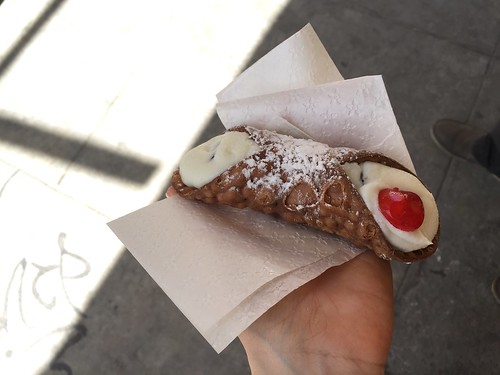
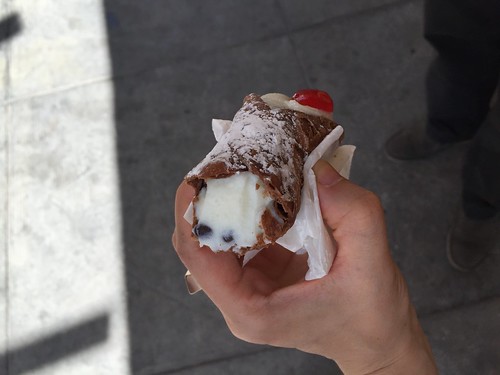
Un Cannolo Siciliano from Palermo's Figli Rosciglione

image

I ate it before lunch because I was there and wouldn’t be tomorrow. When she said ‘vi faccio subito’ — I’ll make them straightaway — I knew this cannolo wouldn’t taste like the concrete-filled versions I grew up with.

For many American tourists, the cannolo — or Americanized singular cannoli — epitomises Italian pastry. But following the American Grand Tour of Rome-Florence-Venice won’t yield any. At least not any good ones. That’s because the cannolo — and all manner of ricotta stuffed pastries — hails from Sicily. While certain foods have banished their provincial affiliations to become symbols of italianità — like pizza, tiramisu and risotto — others have stayed within regional borders. Asking for un cannolo in a mainland pasticceria yields a light, flaky pastry stuffed with cream as opposed to the crisp, chocolate-chip and ricotta filled dessert familiar to Americans. In Italy, the cannolo’s territory is Sicily.

Accustomed to choosing a crostatina over a cannolo, I didn’t think of them until my final day in Palermo when I found myself standing in front of Fratelli Rosciglione on the edge of the city’s gritty Piazza Ballarò market. A small, graffiti covered sign advertises Rosciglione on the rundown residential street. Appearances don’t improve inside. Empty metal tables gleam where you expect to see pastries on display. Only flimsy plastic boxes of cookies suggest you’ve entered a pastry shop. There were none of the Italian-bakery symbols from my youth. There was nothing that prepared me for a cannolo.

image

Then it arrived. The woman behind the counter brought out my pastry on a cracked plastic tray. She placed it down and asked for the money with such nonchalance that I realized serving a la minute cannoli was to her as normal as eating leaden, pre-packaged pastries was to me.

I waited until I was outside to begin. My teeth pierced the crunchy shell, still light from frying. The sweet, tangy ricotta dissolved like frosting. Occasionally a mini-chocolate chip offered rich relief. Then, just as I hesitated to take my first bite, I reluctantly ate my last. This wasn’t the cannoli I grew up with. It was un cannolo siciliano. It was the best thing I ate in Sicily.

Dining in Art: Bar Luce at Fondazione Prada in Milan

Bar Luce

Photos of Bar Luce present a fanciful vision of 1950’s and 1960’s Milan. Pristine plastic chairs gleam and swank film-themed pinball machines beckon. This is the Italian bar filtered through director Wes Anderson’s meticulously fantastical lens. But the reality appears less pristine.

Bar Luce, which opened earlier this year along Milan’s industrial Largo Isarco, is a fully functional café that Anderson designed in collaboration with Fondazione Prada, the contemporary design museum founded by fashion-authority Miuccia Prada. Every detail in the bar evokes a chic Milanese hangout from the boom economico. Maybe Prada imagined it not only an antidote to the rote bars that dot Milan’s vie and viali, but also a watering hole for the Milan’s contemporary cognoscenti that signals a return to the city’s primacy in the realms of style and culture. Or maybe not.

The diner at Bar Luce never forgets they are in a re-imagined museum cafeteria. Rather than gaze onto the street, a wall of windows runs down the left side of the café, opening onto the museum’s courtyard. Yet the windows also frame the café, positioning Bar Luce as an art installation with which individuals may interact. Visitors enter the café from the courtyard as if approaching another exhibition hall. From the street, only a thin neon sign advertises the bar, dissuading those unaware of Bar Luce’s from entering. Through controlling the entrances, Fondazione Prada ensures Bar Luce’s community of diners experiences the space as another exhibition room.

Yet the visitors must interact with this exhibition, making it seem like a performance piece in constant development. They must choose whether to sit or stand at the bar; whether to eat or drink. There’s generic menu with offerings identical to those found at every bar in Italy: sandwiches with prosciutto and mozzarella, aperitivi, coffee. These bland options suggest that the food isn’t Bar Luce’s focus. The focus is fantasy. Customers indulge in it through entering the menu, absorbing the faux-typewriter font and chatting with waiters dressed to appear in Anderson’s next film. While the preparation and consumption of food and drink give Bar Luce its social function, locating the bar in a museum restricts its purpose to cultural consumption. Whether they choose to play pinball, eat breakfast at the bar, or chat with friends over a sandwich, community members interact with Anderson’s vision of prosperous Milan, reinforcing Bar Luce’s status as art piece rather than restaurant.

Although Fondazione Prada presents Bar Luce as an exhibition, Anderson describes another side to the cafe, “I think it would be an even better place to write a movie … I tried to make it a bar I would want to spend my own non-fictional afternoons in.” While it may seem that Anderson’s ideal writer-creator customer opposes Fondazione Prada’s preferred culture-savvy clientele, words such as ‘would’ and ‘want’ suggest that Anderson realizes his projected diner differs from the actual patrons. The people who frequent Bar Luce would like to write movies on the formica tables. They would want to pass afternoons playing pinball. But they are visiting Fondazione Prada so instead they refuel with a coffee and a sandwich before consuming more art.

Bar Luce can’t escape its function as a museum cafeteria and as an installation art piece. The design may highlight Anderson’s famously quirky sensibility, but Fondazione Prada directs the space’s use. Entering, ordering, and consuming builds an experience that allows visitors to momentarily live as a glamorous Milanese from a Wes Anderson film. Within Bar Luce a hybrid past-future fantasy comes alive where Milan retains a perfectly orchestrated glamour lost in the chaos of Italy’s current contemporary woes. Unfortunately, the characters are visitors who will soon leave both the bar and Italy, taking home only their experience of art.